The African Grove Theater and the Fight for Narrative Authority
When William Alexander Brown opened the African Grove Theater in 1821 in a country that still enslaved his people, it was unsurprising that white critics arrived not to appreciate art but to mock the attempt. However, what they saw was what they feared most: that theater is not bounded by race but by a desire to control one’s own narrative, a desire that many African-Americans strongly held. The opening of the African Grove Theater in New York City on September 17, 1821, was the starter fluid that set ablaze a new era of minority creatives taking the lead in theater. William Alexander Brown dared to create an all-Black theater at a time when slavery was still rampant in the United States and wouldn’t end for multiple decades. He created a place for Black creatives to pursue the arts, a place where they were previously told they didn’t belong. The African Grove’s impact at the time of its creation and on future generations demonstrates how it’s impactful not only for being the first Black theater but also for paving a path for minorities to have a place in predominantly white fields. Although the African Grove only operated for two years before shutting its doors for good, it suggests that authentic minority representation in musical theater isn’t accomplished just by having minorities on stage, but by allowing minorities to have the authority to control the narrative.
The state of Black representation in theater before the African Grove was bleak. In the article, “Breaking Boundaries: Black Musical Theater and Artistic Individualism,” the way Black people used to be represented in theater is explained: “The ‘inclusion’ of people of color in productions first began with actors dressing up and using makeup to change their appearance to mimic those of non-European descent in stereotypical ways” (“Breaking Boundaries”). Black people’s first representation in theater was used as a chance to mock and belittle them. When other people could control how they were represented, it was through stereotypes. This form of representation acted as social control, affecting the ways in which white people understood and related to Black people. Not only was this despicable representation common in theater, but it also became ingrained into the American psyche. The article goes on to explain, “While Jim Crow laws dehumanized Black people through legal procedures, the Jim Crow minstrel character dehumanized them through societal pressure. Minstrel shows were so normalized that Mark Twain, ‘the father of American literature,’ seemed to not understand their negative effects. Reminiscing about the ‘death’ of minstrel shows, he stated that ‘[the show] was a thoroughly delightful thing and a most competent laughter-compeller, and I am sorry it is gone” (“Breaking Boundaries”). Minstrel shows only served to dehumanize Black people in the minds of the American people. When every representation had Black people represented in the same manner, it became normalized to just view African-Americans that way, showing the dangers of not being able to represent oneself. Minstrel shows demonstrated that “representation” without narrative control only serves to reinforce negative stereotypes.
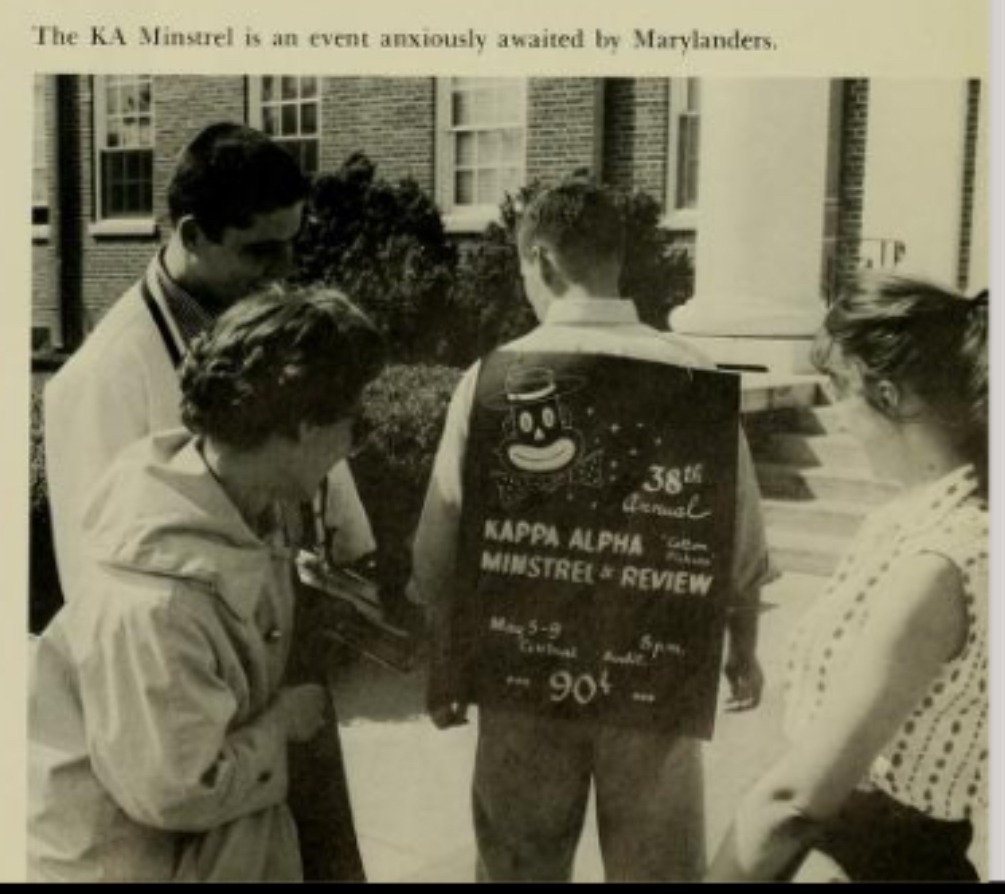
Minstrelsy’s dehumanizing nature extended past the 19th century, into the college campus life of the twentieth century. In the image below, a photograph from the University of Maryland campus shows a poster advertising the “38th Annual Kappa Alpha Minstrel Review” for ninety cents, featuring a caricatured blackface figure (“Breaking Boundaries”). The fact that such a racist event could be widely advertised, and awaited by Marylanders shows the dangers of racist representation. Although the African Grove fought to establish Black narrative authority in 1821, white institutions continued appropriating and stereotyping Black culture for more than a century. This demonstrates that although Black representation is good, real change can’t be accomplished without broader structural transformation. The African Grove was a monumental first step, as it allowed Black actors to shift the narrative away from these racist caricatures.
In contrast to the minstrel shows, the African Grove Theater was a site for Black creatives to flourish. The gallery, “Transformation! : African American Theater 1821-1921 and Beyond,” discusses how the African Grove allowed for new avenues for Black people in theater: “Through the incorporation of Shakespearean performances, popular songs, original texts, and folk favorites, it demonstrated the range of Black subjectivities and creative expression while offering the possibility of a truly populist and popular national theater” (“TRANSFORMATION”). Additionally, in the news story “The Transformative History of African American Theater: From the African Grove Theater to ‘Shuffle Along’,” Sarah Binney had the chance to interview those who worked on the gallery. They said, “The first play written and produced by Black actors was staged in the African Grove Theater. It wasn’t common for women to be a part of productions and the African Grove Theater also gave women that space” (Gabriela). These two texts illuminate the opportunities the African Grove provided. They performed Shakespearean plays, which challenged the preconceived notion by white artists that it’d be too “complicated” for Black people to handle. However, the choice to perform Shakespeare also reveals a complex contradiction. By mastering prestigious European drama, they simultaneously challenged the preconceived notions of their capacity while also using the same system they were trying to revolutionize. Both resisting and accommodating white cultural standards characterizes much of the theater’s earlier work. Additionally, they allowed Black people to write their own plays, which gave them full control of how they were represented, and even gave women a more prominent role as well, showing how influential the theater was in giving voices to the voiceless. The power to write was the highest form of narrative control.
The African Grove demonstrated Black agency and the right to belonging. As explained in the article “The African Grove Theatres, Then and Now: Performance as Activism,” by Jenna Gibbs, the African Grove was a site for Black individuals to portray powerful narratives related to their strife at the time.“To do so, they performed plays that featured black protagonists with powerful agency, coupled with insistence on cultural belonging in the United States: Jack Mansong, in Obi; or Three Finger’d Jack, a maroon rebel who stages regular attacks on slave plantations in Jamaica; black dandies in Tom and Jerry; or Life in London, who claim for themselves equal access to fashion and middle-class life; and Richard III, asserting the cultural right to share supposed ‘white’ literature and culture,” (Gibbs 102). Comparing this to the roles African Americans were given in the past is a stark contrast. The African Grove allowed for Black creatives to create art that was pertinent to their struggles and make it for anyone to see. They made plays that showed their right to rights that were assumed only for whites. The maroon rebel who staged regular attacks on slave plantations is particularly striking because it was at a time when slavery was still going on! The African Grove didn’t just let Black people and women onto the stage; it put them behind the pen as well and allowed them to perform their struggle.
The African Grove wasn’t only groundbreaking at the time but has left a lasting impact. Gibbs also explains, “Remarkably, despite its short life, the African Grove Theatre not only had a transatlantic reach in its time, launching the successful careers of two black Shakespearean actors, James Hewlett and Ira Aldridge (whose work is examined by Sede Makonnen in this issue), but also imprinting a lasting resonance in contemporary black theatre,” (Gibbs 94). It is particularly the works of Ira Aldridge that will be looked into. Bernth Lindfors discusses the exploits of Aldridge in his article, “”Mislike Me Not for My Complexion…”: Ira Aldridge in Whiteface,” where he explains, “It is clear that in many parts of Britain Aldridge did win the respect of his audiences when he appeared on stage in whiteface. One palpable sign of this is that these audiences evidently found nothing unusual about a black actor playing a white part. Only in London was this remarked upon as “a manifest incongruity.” In provincial reviews there was seldom any reference made to Aldridge’s race; he seems to have been accepted for what he was: a professional actor who could bring alive well-known Shakespearean characters. It didn’t matter that the characters were white and the actor black,” (Lindfors 353-54). Here a complete flip of the origins of Black people in theater is shown. Originally, white people would use blackface to mock Black people and belittle them. Then, Ira Aldridge uses whiteface, a complete reversal that shows how Black creatives could now fully control their narrative and do what was necessary creatively. However, the triumph of Ira Aldridge also carries within it complexity: Aldridge achieved success by literally partially covering his blackness. Was this artist fully liberated, allowed to try new processes that a Black actor could never imagine at the time, or was this acceptance that certain roles naturally suited a white complexion? The answer is likely a complicated mixture, but it was a mixture African-Americans hadn’t had the privilege to before. Ira Aldridge, who got his start in the African Grove, was able to take full control of his narrative and not just be on stage but do things never done before, and he was overall well received for it. His success demonstrates that the cultural impact left by the African Grove persisted even after the theater was destroyed.
The legacy of the African Grove theater is a reminder that true change doesn’t come from a seat at the table, but from being able to speak at the table as freely as everyone else. William Alexander’s groundbreaking idea to open an all Black theater was definitely a risk, and one that didn’t even immediately pay off, seeing as the theater was shut down after a short time. However, the impact that the theater has left on representation in theater is undeniable. The African Grove established a principle that continues to echo through generations of Black production in theater, the silver screen, and the big screen: authentic representation is about authority and control in how one will be represented to the world at large. It is not enough to have minority actors; there must also be minorities that have the power to produce, write, and direct to make sure their cultures and people are represented with dignity and accuracy.
Works Cited
“Breaking Boundaries: Black Musical Theatre and Artistic Individualism – Mapping Music @ UMD.” Umd.edu, 2022, mappingmusic.umd.edu/1970s/blackmusicaltheatreandartisticindividualism/.
Communications, NYU Web. “The Transformative History of African American Theater: From the African Grove Theater to “Shuffle Along.”” Www.nyu.edu, 2 Feb. 2022, www.nyu.edu/about/news-publications/news/2022/february/the-transformative-history-of-african-american-theater–from-the.html.
Gibbs, Jenna M. “The African Grove Theatres, Then and Now: Performance as Activism.” Nineteenth Century Theatre and Film, vol. 52, no. 1, 21 Apr. 2025, pp. 94–115, https://doi.org/10.1177/17483727251324211. Accessed 9 Oct. 2025.
Lindfors, Bernth. “‘Mislike Me Not for My Complexion…’: Ira Aldridge in Whiteface.” African American Review, vol. 33, no. 2, 1999, pp. 347–54. JSTOR, https://doi.org/10.2307/2901283. Accessed 24 Nov. 2025.
“TRANSFORMATION!” The Gallatin Galleries, 15 Nov. 2021, wp.nyu.edu/gallatingalleries/transformation/.

This entry is licensed under a Creative Commons Attribution-NonCommercial-ShareAlike 4.0 International license.

